"30% on order, the balance when the job is done." If you are a tradesperson, an installer or a service provider, you know the formula. It protects your cash flow and commits your client. But behind it, you need several invoices, and they have to add up to the cent.
Here is how to issue a deposit invoice by the book, what VAT changes, and how the final invoice deducts what has already been invoiced. The rules described in this article are French rules.
Deposit or earnest money: one word changes everything
Before the invoice comes the quote, and a word to choose carefully.
- A deposit ("acompte") is a first payment. It commits both you and your client. If the client changes their mind, you can demand payment of the rest. If you are the one who backs out, you must refund it, and the client can claim damages.
- Earnest money ("arrhes") leaves each side a way out. A client who withdraws loses it. A business that withdraws pays back twice the amount.
With a consumer, French law settles the question when the contract is silent: unless stated otherwise, money paid in advance counts as earnest money. So write "acompte" in black and white on your quote.
A deposit invoice is an invoice like any other
Between businesses, every deposit paid before the sale or service is carried out requires an invoice. Not just the final payment: every payment.
It carries the same details as a regular invoice:
- its date, and a unique number that follows the continuous sequence of your invoices;
- your details and your client's;
- a precise description of what you are selling;
- the amount excluding VAT, the VAT rate and amount, and the total due;
- the date the deposit was paid, if it differs from the invoice date;
- the payment date, the late-payment penalty rate and, for a business client, the €40 fixed debt-collection fee.
There is some flexibility: if a piece of information is not yet known when you invoice the deposit, such as the exact date of the transaction, or a variable quantity or price, the deposit invoice may leave it out.
Take care with the description. The French tax authority is clear: VAT only becomes due on a deposit if what will be delivered or carried out is already precisely known. "30% deposit on quote no. 2026-014, installation of a heat pump" is better than a plain "deposit".
If you are under the VAT exemption scheme ("franchise en base"), your deposit invoice is issued without VAT and carries the statement "TVA non applicable, art. 293 B du code général des impôts".
What about e-invoicing? It covers invoices between businesses established in France, and a deposit invoice is one of them. Since 1 September 2026, every business must be able to receive e-invoices. Small and medium-sized businesses and micro-enterprises will have to issue them from 1 September 2027. The reform also adds four details: your business client's SIREN number (their 9-digit company ID), the delivery address if it differs from theirs, the type of transaction (goods, services, or both), and, if you chose that option, the statement that you pay VAT on an invoicing basis ("Option pour le paiement de la taxe d'après les débits"). For consumer clients, there is no e-invoice: data about your sales is reported to the tax authority instead.
VAT on a deposit is due when you receive it
This is the point that surprises people most. As a general rule, VAT on a deposit does not depend on the date of your invoice, but on the day the money arrives.
- For a service, VAT is due when each deposit is received, then when the balance is received, unless you have opted to pay VAT on an invoicing basis.
- For a sale of goods, since 1 January 2023, VAT is due as soon as the deposit is received, up to the amount received. The rest is due on delivery. Without a deposit, all the VAT is due on delivery.
In practice, VAT on a deposit is declared for the period in which you receive it. Unless you pay VAT on an invoicing basis, a deposit that is invoiced but not yet paid does not make you pay anything yet.
The final invoice: restate the total, deduct the deposits
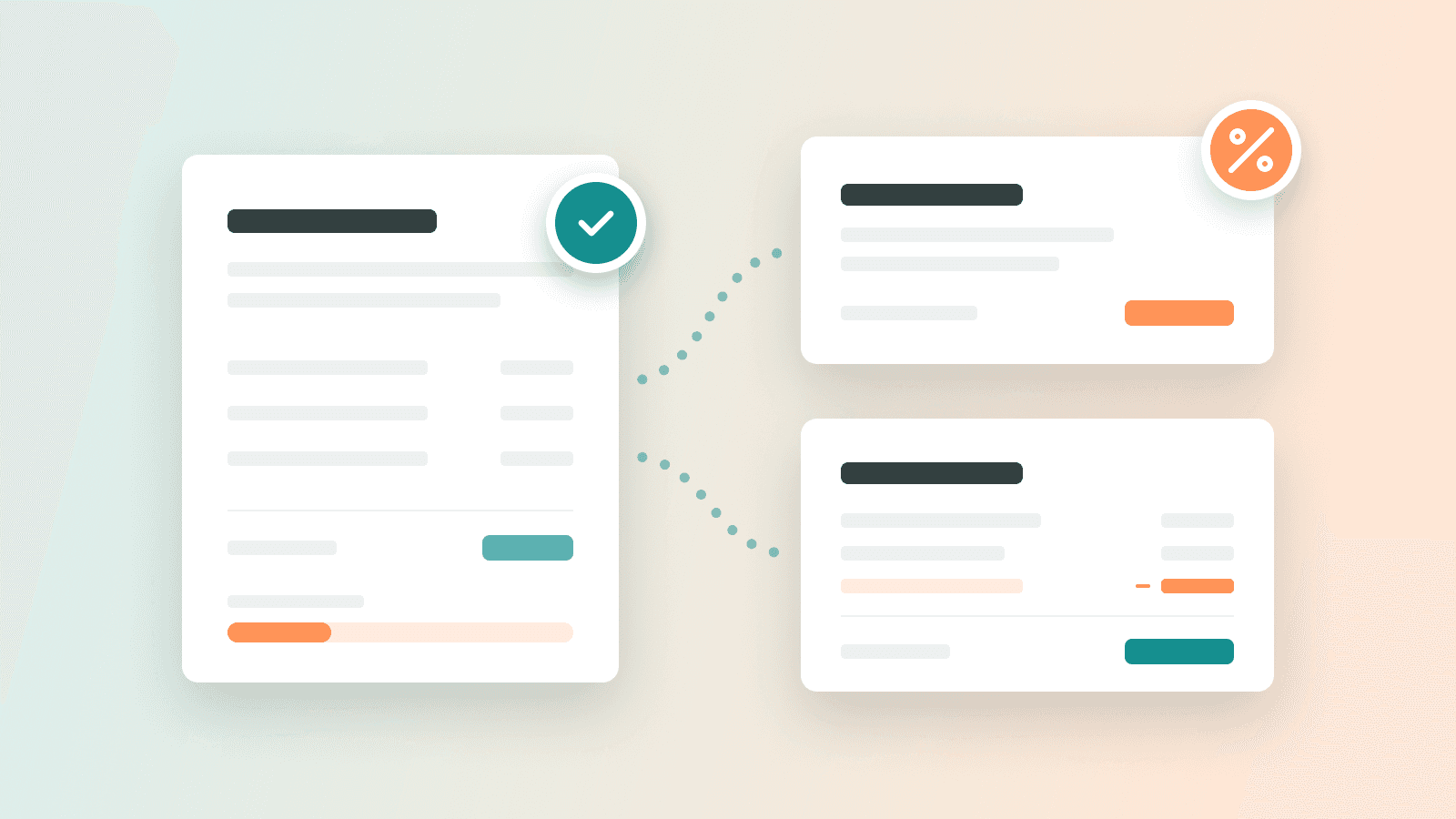
The final invoice closes the transaction. It restates the full amount of the sale or service, refers to each deposit invoice by its number and date, then deducts the deposits already invoiced. French tax rules require the final invoice to refer to the deposit invoices. The deduction itself keeps your client from paying the same amount twice, and the deposit's VAT from being counted twice.
An example, with 20% VAT:
- quote: €10,000 excluding VAT, or €12,000 including VAT;
- 30% deposit: €3,000 excluding VAT plus €600 VAT, so €3,600 to pay;
- final invoice: the €12,000 total, minus the €3,600 deposit already invoiced, so €8,400 to pay, including €1,400 of VAT.
The most common mistakes: forgetting to deduct a deposit, deducting a deposit that was cancelled, or leaving a rounding gap between the sum of your invoices and the quote total.
With AngelStart, the deposit starts on the quote
In AngelStart, everything starts on the quote. In the Payment section, just below the payment terms, the "Deposit on order" field is set to "None" by default. Choose a percentage: it is printed on the quote with its amount including VAT, and your client sees it on the page where they accept the quote. The deposit is part of what they accept.
Once the quote is accepted, "Invoice the deposit" prepares the deposit invoice, with the quote's percentage already filled in. You can change it. The amount is calculated by AngelStart from the quote, VAT rate by VAT rate.
Need a second payment? "Invoice another deposit" stays available until the balance is issued.
When the work is finished, "Invoice the balance" takes the lines of the quote, restates its total, then deducts each deposit issued, with its number and date. The amounts due on your deposits and your balance add up, to the cent, to the quote total. A deposit cancelled by a credit note is not deducted.
Deposit invoices and final invoices are ready for e-invoicing: each one carries its type there, deposit or balance.
In practice: four habits
- write "acompte", and its percentage, on the quote;
- issue an invoice for every deposit paid, numbered in your invoice sequence;
- declare the deposit's VAT for the period in which you receive it;
- on the final invoice, refer to each deposit and deduct it.